How to build a FinTech app: Looking forward to 2026
Dec 16, 2025
•
10 min
•
Feb 26, 2026

Written by: Alans Romanovs
Job Title•Marketing Specialist @ Chili Labs
Building a FinTech application is nothing like developing a typical mobile app. You’re working in an industry where users are trusting you with their money. That’s why they expect absolute reliability, security and performance. At Chili Labs, we have delivered banking, payments, lending, Forex trading, crypto, insurance, and other FinTech apps used by millions of people.
We spoke with Edgars and Kristaps, two of our project managers who have collectively led 12 FinTech projects across native Android, native iOS and Flutter, to break down what really matters in FinTech.
1. The main difference
FinTech apps stand apart for three reasons: regulation, security, and complexity.
“FinTech apps are heavily regulated, requiring region specific permits, certifications, and licenses before launch. Each app store also has its own rules, so even if your app is approved in Google Play, it may still fail review in the App Store, AppGallery, or other platforms.” — Edgars.
Security plays a crucial role in FinTech app development. Standards are higher, audits are stricter, and even the smallest flaw can trigger a rejection after review.
“Everything must be safe, fast, consistent, and understandable. People are using real money and won’t tolerate confusion or lag.” — Kristaps.
2. Initial Planning
Code rarely kills a FinTech project, poor preparation does. Here’s what both PM’s consider essential:
Clarify the scope and build a MVP strategy
Clients often want a fully-featured app on the first launch. That’s a common mistake.
“I help clients prioritize the core: launch an MVP first, collect feedback earlier, and scale once the base is solid.” — Edgars.
Validate permits, licenses, and regulatory readiness
This prevents painful delays when it’s time to publish. It’s necessary to check if a company has all the required permits and licenses so it doesn’t get blocked when we try to publish the apps.
Conduct technical audit
Especially when the backend belongs to the client, it’s necessary to understand if there are any limitations we need to address to avoid surprises.
“We check how well the backend is built, identify any limitations, and determine the necessary workarounds to keep the app running smoothly.” — Kristaps.
Analyze competitor apps
There are countless apps in the stores. Competitor analysis is essential to identify strengths, weaknesses, and opportunities for building a better app that aligns with the client’s vision.
3. Technical strategy
 Security, certifications, and platform rules
Some of the biggest challenges were already mentioned: permits, certifications and licensing for each operational region. Another major challenge is ensuring that everything works as good and reliably as possible. Since FinTech apps operate with real money, they require complex integrations with payment providers, safeguards against malicious software, and other security measures. To address these challenges, we always propose solutions that best fit the project’s requirements.
For example: Caching, silent reloads, and offline access is easy to implement on paper, but it becomes much more complex when sensitive data is involved. Those elements require extensive testing under different network conditions, devices, and scenarios.
Platform-specific privacy and security rules. Both Android and iOS have strict guidelines for how financial data is stored, synchronized, and accessed. Over time, Chili Labs has built internal processes to pass audits faster and meet these requirements without slowing down the development.
This is where FinTech engineering becomes multidimensional: compliance, performance, and security must go in parallel. The right architecture saves months of work and helps to avoid costly mistakes after the app goes live.
Handling edge cases
There are countless edge cases that seem unlikely to occur. We cover as many as reasonably possible, but by definition, most are rare or unexpected.
Some flows look simple until you add real-world behavior.
“A user initiates a payment, and while it’s being processed, their network connection gets lost for a moment. We need to ensure the transaction is processed securely even in cases like this.” — Edgars.
“Many teams aren’t planning for all the different transaction types and methods, and don't consider how large user balances or transaction lists can get. Real data breaks UI if it’s not designed for scale.” — Kristaps.
Scalability from day one
For Chili Labs, scalability starts with one core rule: no temporary solutions. Over the years, clients have made similar suggestions countless times: “Let’s do this for now, as it’s quicker and easier, and we’ll implement a proper solution later.”
But in reality, that “temporary fix” almost always becomes permanent until something breaks. And when it finally does, it usually costs more time and money to fix than to build it properly from the beginning.
That’s why we follow a strict principle: if it needs to scale, either build it right or don’t build it at all.
Both PM’s agree on same ideas:
- No temporary fixes
- Build reusable components
- Think for the long-term
4. Choosing the right stack
 When it comes to building FinTech apps, there’s no definite solution. Our PMs have differing opinions on whether native technologies or cross-platform solutions are the best choice. Each approach has its advantages, and the right decision depends on the app’s complexity, performance requirements, and long-term maintenance goals.
For complex FinTech products, the choice of technology often comes down to flexibility versus efficiency. Native development is frequently favored when apps become heavy, highly customizable, and packed with advanced logic, as it provides deeper control over performance and platform-specific capabilities.
At the same time, cross-platform frameworks like Flutter are gaining popularity, especially from a business perspective. Maintaining a single codebase can significantly reduce development and support costs without sacrificing quality in many scenarios.
“We’ve developed several FinTech apps using Flutter, providing a native-like and reliable experience. From a business point of view, it’s often more efficient because 1 developer can maintain both platforms. I still personally prefer native technologies: Kotlin with Jetpack Compose for Android and Swift with SwiftUI for iOS. FinTech apps can become very complex, with many customisable elements and strict requirements. Native solutions provide better flexibility with what can be achieved in the app.” — Edgars.
“Lately we’ve been using Flutter for most FinTech projects. It’s reliable, fast, and makes long-term maintenance much easier. Our experience has shown it works really well for these types of apps.” — Kristaps.
Advantages of Flutter app development:
- consistency is needed across iOS and Android
- the product evolves quickly
- cost-efficiency matters
Advantages of native app development:
- custom UI/animations are highly advanced
- handling of extremely complex flows
- maximum platform control is needed
Both our project managers agree that in the end there’s no single right answer, the decision depends on the goals and requirements of the project.
5. Testing & QA
 In FinTech, testing is a critical part of building trust. However, there’s an important distinction that people often overlook:
Testers focus on functionality. They verify that the app works as intended, report obvious bugs, and ensure no major issues prevent users from completing key actions.
At Chili Labs, we focus on QA (Quality Assurance) rather than just testing. It ensures the app is truly high-quality, covering edge cases, UI consistency, translations, and subtle interactions that testers might overlook. They suggest improvements and check that even rare scenarios won’t break the app.
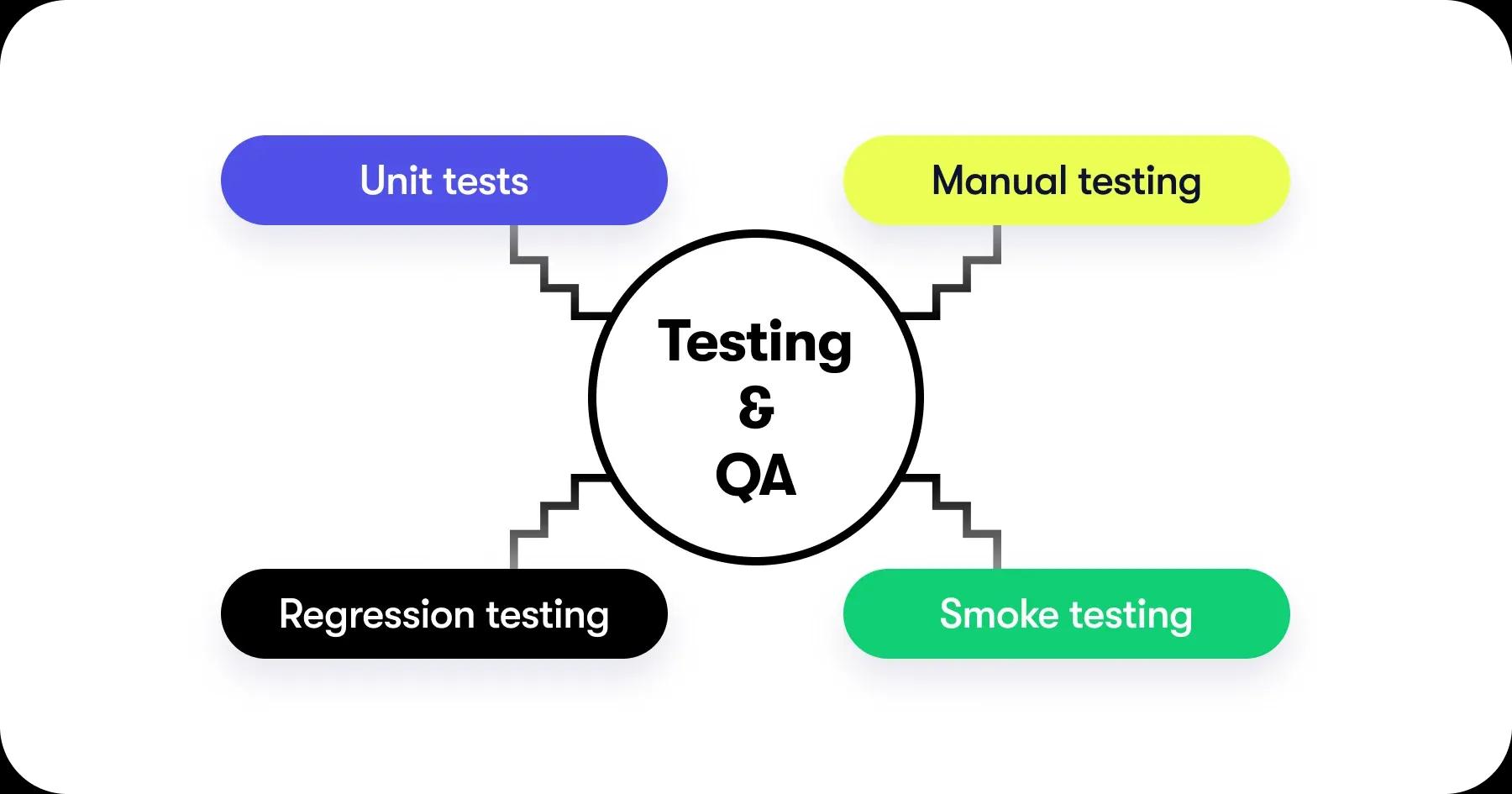
During development, we use multiple types of testing depending on what’s needed:
- Unit tests. Small, isolated blocks of code (usually functions or methods) are verified for accuracy. It helps prevent bugs from propagating.
- Manual testing. QA tests the app on physical devices to ensure features match requirements and behave correctly.
- Smoke testing. Quick checks of key features, often before minor releases, to ensure new updates don’t affect main flows.
- Regression testing. Before deployment, we check every function to make sure recent changes haven’t broken anything.
Other tests exist, but these four cover the most of what we rely on for reliability. In FinTech, even a small bug can affect real money or user trust, so this multi-layered approach is essential.
6. Pre-launch challenges
Main blockers appear right before launch:
- The app must undergo a security audit performed by a third-party company to ensure it complies with all security requirements.
- There are extensive questionnaires in the Google Play Store and App Store console that must be completed by the client’s company. Apps cannot be published if these are not filled out. The stores also review the responses thoroughly, so any inconsistencies or issues can result in rejection or requests for additional information from store representatives.
- This is the final stage to ensure that all required permits, certifications, and licenses are in order, and that each operational region is correctly selected. If there are any issues, the app may be rejected.
7. Launch, Scaling & Ongoing Support
Launching the app is a key step, but ongoing work starts immediately after. Here’s a checklist of essential activities that should be performed after launch:
- Monitoring of crash analytics (every user matters early on)
- Regular security updates
- Performance improvements based on real usage
- User flow optimisation through event data
- Adaptation to new regulations or auditor requirements
After looking into the points mentioned above, it’s also a good idea to invest in ASO (App Store Optimisation). It helps to understand what to write in your store listing to make your app more visible to users. Even small changes, like updating used keywords, can boost your rankings from the top 50 to the top 10 in a matter of weeks.
8. Data & Analytics: What Really Matters
Custom event tracking is very important. It shows exactly where users struggle: onboarding, transaction steps, purchase flows. These insights help to identify trends and decide which parts of the app need improvement. Analytics drives real growth in FinTech. The most important metrics summed up:
- Crash-free user rate
- Performance of critical endpoints
- Daily active users & retention
- Onboarding funnel metrics
- Transaction flow events
- Drop-off points
As your app grows, those metrics become increasingly important. With countless competitors, you need to make sure that your app stands out. The main features should be easy to use, and users should be engaged and eager to return every day.
9. Lessons Learned
 Most challenging features
Our project managers highlighted the features and scenarios that present the biggest challenges in FinTech app development:
“The toughest challenge was a client-owned authenticator feature that allowed users to mark their device as trusted, effectively replacing standard 2FA. The main difficulties were extremely strict security requirements and post-launch bugs. Some of these issues were highly device-specific, difficult to reproduce, and almost mysterious, which made debugging challenging.” — Kristaps.
“There isn’t one specific feature, as new challenges arise all the time. It’s always difficult to create or update something without clear requirements, when you’re analyzing the general idea and creating an action plan based on an insufficient amount of known facts.” — Edgars.
Where projects lose momentum
There are several scenarios where a project can lose momentum, and one of them is having unrealistically high post-release expectations.
Usually, a large influx of new users is expected after the first launch, but without a major marketing campaign, there may be only around 10-20 new users in the first month. At this stage, it’s easy to feel that all the investment was wasted and that the app has no future.
To achieve steady, sustainable growth, a few practices are essential:
- Narrow the MVP - You don’t need a fully functional clone of a competitor to get your app published. Focus on key features first.
- Iterate - Launch the MVP and continue developing new features for the next releases.
- Analyze data - Monitor events, user retention, behavior, and performance. Understanding what users actually do in your app and where they encounter issues is far more effective than subjective opinions on the next great feature.
- Invest in ASO - Optimise your app store information to make your app more discoverable to users.
- Keep things simple - If a feature is present in a competitor’s app, there’s no need to add it just in case, it might hurt the UX. It’s better not to overcomplicate things initially just to stand out.
Delays may occur due to unclear requirements or sudden changes mid-project. We try to avoid this by gathering as much detail as possible upfront and validating everything early.
For FinTech apps, certification can also slow things down. Since this process isn’t fully under our control, we always inform clients in advance that Apple or Google may require additional approvals, so they can prepare ahead of time.
Final thoughts
FinTech apps require stronger security and naturally involve more complexity, but at the end of the day, the development process remains as usual. The key is knowing the potential challenges of each project so issues can be avoided before they appear.
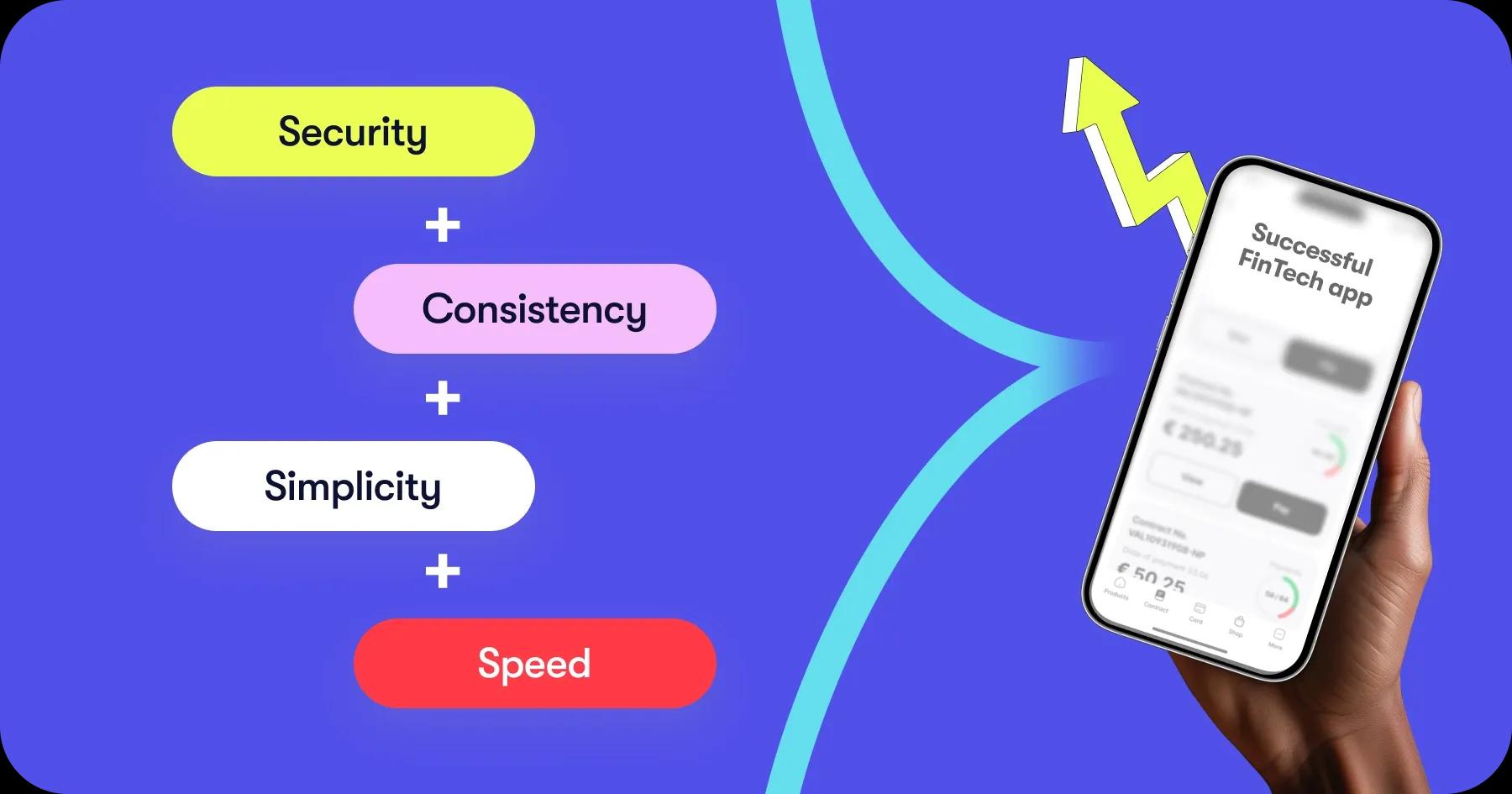
From UX perspective, the formula to build a successful FinTech app looks like this:
Security + Consistency + Simplicity + Speed
If any one of these breaks, users lose trust — the core currency of FinTech.
Building a FinTech app is complex, and everyone on the team plays a crucial role in achieving a successful outcome. With a strong team, careful planning, strict security, and continuous iteration, you can deliver a product that not only works flawlessly but also earns users’ confidence from day one.
Similar articles
Discover more with our related articles section. Stay informed about mobile app development, event organizing, and more.
The Near Future of Apps: Personal, “Real,” and (Mostly) Hybrid
Predicting the future of apps is risky—but imagining it clearly helps us prepare. Here’s where things seem to be heading...
How to Make the Most of Your Mobile App: 12 Proven Strategies
Developing a mobile app is one thing, but making it noticed and truly successful is another. This is a constant...