Big vs. Medium Clients In Application Development: Why They Need Different Project Management Approaches
Jul 07, 2026
•
15 min
•
Jul 27, 2026

Written by: Vjaceslavs Kreidikovs
Job Title•CEO @ Chili Labs
In application development, a 50,000 Euro (Medium) client is fundamentally different from a 250,000 Euro (Big) client. And no, it’s not just about the extra zero on the invoice.
After 10 years of running my own mobile app development company and managing multiple app development projects before, I’ve seen that the "Big Client" and the "Medium Client" require entirely different project management approaches. If you treat them the same, you risk losing both.
 I am Vjaceslavs, the CEO of Chili Labs, and here are my two cents on how project management for big clients vs. mid-sized clients differs. I speak about the gap in expectations of communication, delivery and outcomes, and why one approach doesn’t fit all.
I hope these notes will be useful for CEOs and managers who want to learn how to select a reliable app development partner, what questions to ask them, and how to build the right management framework that helps you avoid some common pitfalls.
Communication Management in Big vs. Medium Project: Who Are You Talking To?
The first and foremost difference between big- and mid-market project management is communication.
In a medium-sized project, the Founder or CEO is directly involved in the communication. They are doing a lot of the work themselves; in most cases, they know exactly what they want and want it built fast.
If we manage a mobile app development project for a mid-sized client, we already know the communication will be very tactical. They feel a specific feature is missing, and they are paying money to build that exact, feasible, and palpable thing. The feedback comes from one person, and within hours of the same day, documentation is “nice-to-have,” but not mandatory from the start, and change requests are discussed verbally on Zoom. All the communication and approvals are received via quick messages in Slack.
The communication style with a big client is different. To illustrate this, let’s take an enterprise client, such as a bank ordering Flutter mobile app development to reach wider audiences in FinTech.
In such a project, the just-build-the-feature approach doesn’t work. The CEO is not involved in communication directly - they delegate it to a top manager or a head of a dedicated team. Each decision should pass several layers of approvals. The feedback is collected from different stakeholders and arrives in days or weeks, not hours. Short feature-discussion sprints are replaced by in-depth planning and meetings scheduled a month in advance. Much time goes to thinking about the impact, and planning and documentation are mandatory for accountability.
A good vendor should understand the difference between these two communication styles, and as a business owner, you can speak directly about their readiness to fit your needs.
If you are a mid-market client ordering, for example, cross-platform mobile application development for your wellness business and are passionate about evolving your ideas in the process, you can ask your software vendor whether they are okay with frequent calls and how they handle change requests.
And if you order mobile application development for a big business, like a bank or an enterprise, check if your vendor can offer a structured communication routine that will respect your schedule, internal procedures and leaves space for multiple stakeholders to be involved.
Project Delivery Big vs. Medium Client: Features vs. Outcomes
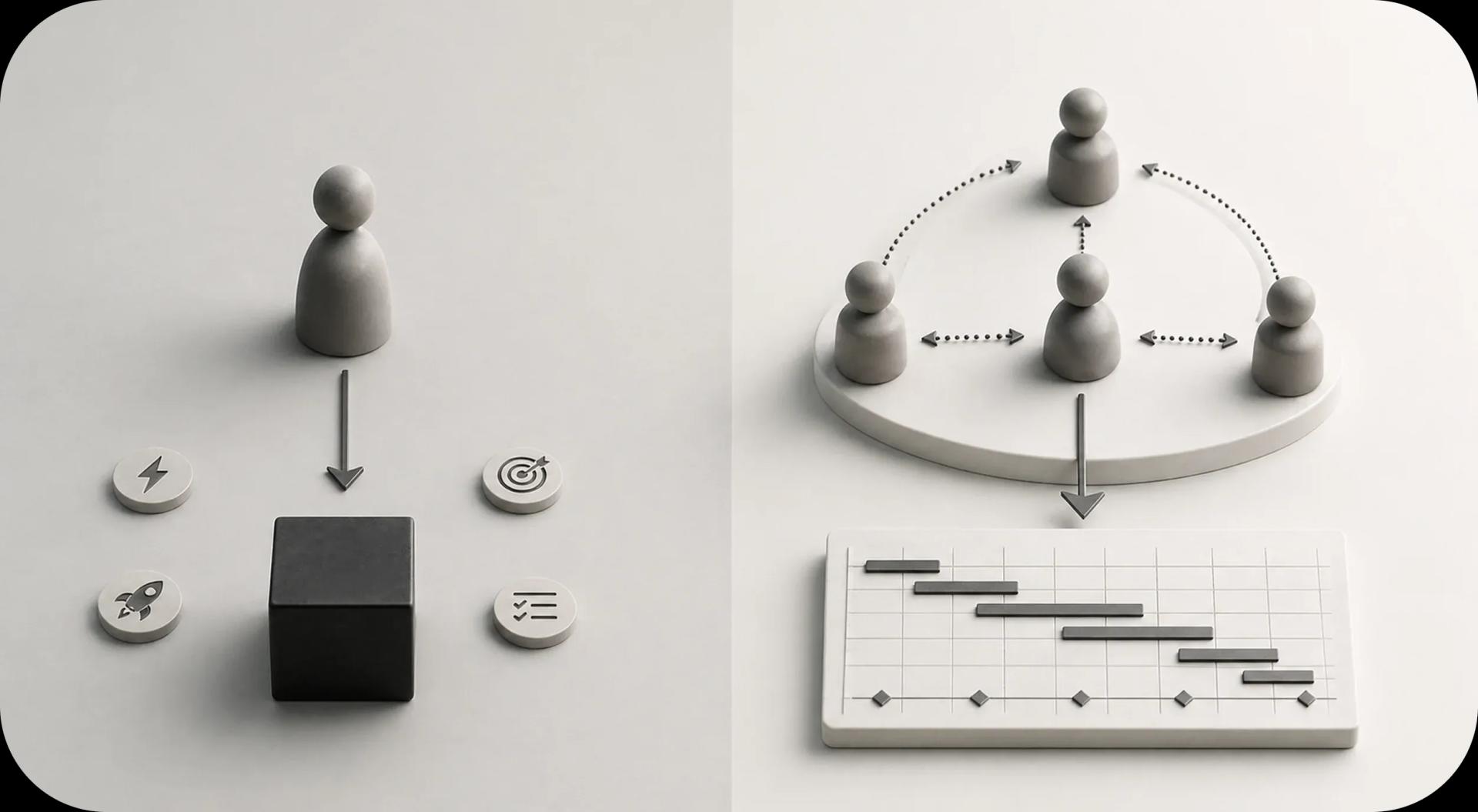
Mid-market client expectations are different from those of enterprise clients. Mid-market clients pay for functions. The conversation usually goes "Hey, let’s do this feature and see how it goes," and the preps come in three short steps: estimate, decision, kick-off.
Enterprise clients manage app development projects, considering the overall impact on their entire business. They pay for outcomes, not features. For example, if we pitch cross-platform mobile application development for them in Flutter, we have to provide proof that the technology is right, that their iOS and Android users will love the app as if it’s native, and that the product development lifecycle will be shorter. As their potential development partner, we must prove our point. Gantt charts, delivery schedules, and multiple layers of management become the key instruments here.
The reason for this is the enterprise approval process. It is generally longer and has more steps to pass.
Business owners looking to hire app development teams should also be careful here. If you hire a mobile application development company that can’t adapt its delivery approach to your exact needs, you risk a good bunch of your time and resources.
Big vs. Medium Project Outcomes: The Profitability Illusion
There is a common illusion that a big client means 5x more profit. Usually, it’s the opposite.
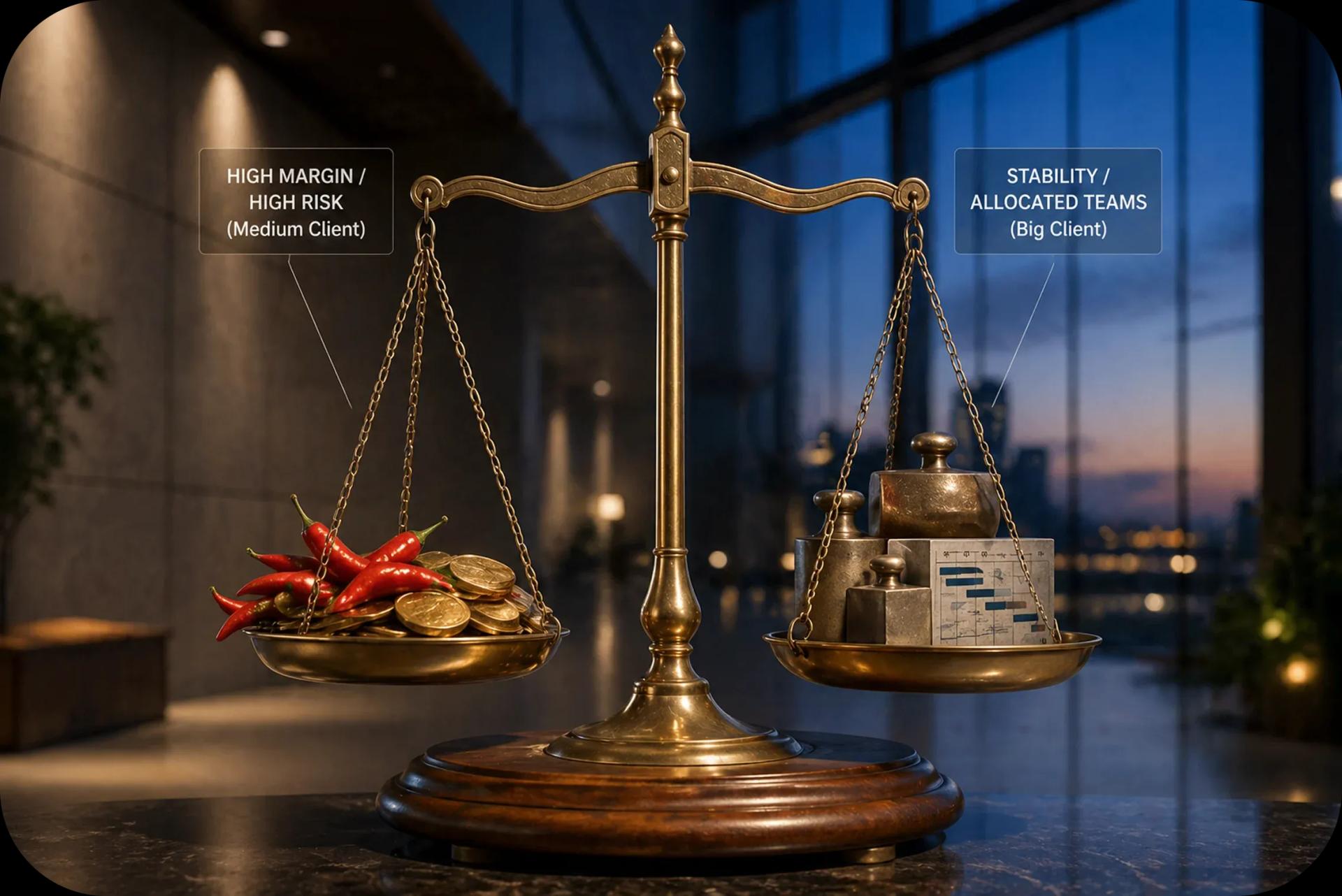
In fact, an average company providing mobile app development services can earn more working with several mid-sized clients. Quite often, projects are similar, and clients come for the solution of typical issues. If developers know what they are doing and have already solved similar problems before, they can kick off projects in days, know where to automate routines, cut out unnecessary hustle, and take on several projects at a time.
Such an approach works especially well for time-sensitive projects. Let’s view a practical case: you run a mid-market business, and you don’t have a mobile app. Your competitor has one and is taking a good part of your clients simply because they love the mobile ordering feature that you don’t offer. You need an app fast, but it should also be cool (the audience is demanding these days).
In that particular situation, we especially recommend Flutter mobile app development, as it significantly reduces time to market.
With big application development projects, revenue and profit are sacrificed for stability.
App development companies love big projects because a big project equals steady workflows and few surprises for the next 9 to 12 months (in terms of people-project involvement). Teams get allocated for the contract duration, and activities are planned for that time.
Yet, handling a project of this scope is also a challenge for a mobile app development company. Such a team has a different discipline that puts documentation, planning, and well-defined workflows in the first place. They also learn how to avoid risks and prepare mitigation plans. Communication is also different - they learn to talk to different stakeholders in their language (features - to marketers, compliance - to legal teams, finance and business outcomes - to owners).
There are more things to be mentioned here, but the main idea is that if an app development company takes a big client for stability, they take an obligation to provide the same stability in exchange.
Big vs. Medium Client Management Challenges: The Value of Risk and Micromanagement
It is a myth that big clients require a lot of communication and effort. Often, smaller clients beat enterprise clients in the number of meeting requests.
Why? Because they are risking their own money. They are risking the cash they could have used to buy a new car or put down a deposit for a house. That makes the value of the final project outcome greater, and there is greater desire for transparency, control, and involvement. If an app development vendor fails to provide that from the start, the client ends up micromanaging them.
The agency’s task here is to provide maximum transparency, ensuring your client knows the project's status. This is achieved through the careful selection of tools, procedures, and routines that enable comfortable stakeholder oversight.
With big clients, managers risk company assets. Their budgets are already allocated, and the psychology here is different: the main focus is on setting up the project and getting it off the ground.
This requires due diligence and procurement on the vendor's behalf, yet once this very difficult step is passed, the subsequent communication becomes less intense. It’s hard to get a big project, but it’s harder to lose it unless the contractor is truly bad at their job.
This point also offers a valuable tip for business owners, as it is very important to ask the right questions before you start development.
If you own a mid-market company, your app will be its flagship product. If you want to be more deeply integrated into the app development project, ask the team whether they are ready to have you on board and whether they have practices in place to ease your involvement.
If you are a big market player and cannot allocate much time to a particular app, check whether the potential team can offer a collaboration method that respects your time while still keeping you updated on the key things you need to know.
Big vs. Medium Clients: Why You Need Both for Successful Mobile Application Development
In my opinion, a truly successful mobile application development company handles a diverse range of clients.
Big businesses focus on security and safety, but leave less space for experimentation and trying. They don’t like leaps of faith or new technology that hasn't proven its impact yet. They prefer slow, steady, and methodical workflows — designs, scoping, wireframes- which are predictable and known in advance. And they expect a vendor to provide workflows that minimize uncertainty.
Small and medium companies are the risk-takers. They take up unique ideas and experiment with new technology stacks and approaches that enterprises don’t risk. They are fast with feedback that helps improve internal processes and love flexibility and innovation. To keep up with their expectations, a mobile app company needs a start-up spirit.
The bottom line: A successful mobile app development company should be able to adapt to both big and medium clients. Their teams should be trained to immediately pick up different workflows: the ones designed for rapid iteration and experimentation and the others, created for disciplined coordination and careful risk management.
The future project's success depends heavily on the vendor’s skill to switch between these two mindsets.
Līdzīgi raksti
Atklājiet vairāk mūsu līdzīgo rakstu sadaļā. Palieciet informēts par mobilo lietotņu izstrādi, pasākumu organizēšanu un daudz ko citu.
How We Failed at Our Own App Development (And Why It Made Us A Better Agency)
Learn why failing your own app development project can make you a better service company...
Ask the Right questions Before starting a UX/UI Design Project
Effective UX/UI design process starts with the right questions. Learn how to prepare for design project by interviewing stakeholders and...